Tuesday, 14 May 2013

Price paid

Yesterday the BRICC family went to pay condolence visits to two people whose mothers had recently died.  One was Saddiq, the education co-ordinator, the other an older man who was a talented footballer in his youth and now helps with the sports programmes.  Nearly a dozen of us walked from the BRICC office the short distance to Saddiq's house, Christians and Muslims together in family feeling in the face of death.  We sat for a while in his living room as several people gave messages of consolation and the love that flowed between this group of very disparate backgrounds was obvious.

We had only been in Nigeria for six months when several people I knew and cared about died in the UK.  With each death a piece of self also dies and a dark yearning emptiness takes its place as we experience the devastation that was never supposed to be part of humanity's story.  Sometimes we are given glimpses into the heart of God.  These can be exciting, exhilerating uplifting experiences or they can be times when the pain and sorrow of this spoiled world almost overwhelms us.  It isn't that God doesn't care when loved ones die; his love conquers all things and he has provided a solution to the agonising consequences of death - Jesus.  There is comfort in the knowledge that death is not the end and we will meet our Christian brothers and sisters again, although even that temporary parting is painful enough.

I got to this paragraph in my daily reading this morning:

We do not understand the mystery of why God allows tragedy, heartache and sorrow but we do know that those who trust the eternal God as their refuge will experience the reality of his promise that "underneath are the everlasting arms" (Deuteronomy 33:27).

Jesus never promised his followers a life without pain but he did promise he would never leave us to make our way through without his help and support.

The heart of Christianity is love - Jesus' love for us, our love for him and for those who would otherwise be lost for ever. There are too many people who, if they were to die tomorrow would face eternal desolation, yet all that is necessary to defeat death is to accept that Jesus on the cross has beaten it and to follow him.  Perhaps it's too simple but the entrance fee to a glorious eternity has been paid, we just have to accept the ticket.


Thursday, 9 May 2013

Cornerstone Academy


Cornerstone Academy is run by SIM's City Ministries in Gero, a village about ten minutes along a dirt track from Bukuru.  It's one of the steps in their ministry to street children and orphans which begins in Gidan Bege (House of Hope in Hausa) in Jos.  That's where rescued children are taken initially and where they stay for about six months until they're ready to be moved to Cornerstone Academy.  After the academy they move back to Jos to Transition House to prepare for the transition from life in a children's to home to independence as adults.


Teacher training
Anne Karin Lauritzen from Denmark supervises the academy and asked if I would go and talk to the Cornerstone teachers about thinking creatively.  It was a challenge and opportunity for me but, as I was going to stress to the teachers, when an opportunity comes along you need to have the courage to take it and have an experience if you hope to learn and develop yourself.  Yesterday I went with her.  We had fun with the teachers and I hope something of what I said was useful to them.  I'm sure that after promoting the memory-enhancing properties of the dopamine produced by having fun, there'll be a lot of laughter coming from the classrooms in the next few days.
We also had some fun towards the end as we discussed such important questions as "Does a sound exist?" "If you could take a pill that would make you always happy, would you?" "Would you rather be brave and poor or cowardly and rich?" - all designed to get the teachers to think and move their brains in different directions.

One of the first people I saw at Cornerstone was Mission Africa's Lynsey Bell.  She goes once a week to help Emma (short for Emmanuel), a boy who was found abandoned in the bush a few years ago.  She works with children with special needs in Jos but goes to give Imo the one-to-one attention he needs.  He can't communicate very well and lacks most of the skills of a boy his age.  She suspects he's autistic which is probably why he was left to fend for himself from very young.

Before we went back to Bukuru Anne Karin had to visit one of the boys' boarding houses.  A supporter had paid for new beds so a photo had to be taken.  The boys all shouted happily that they loved their new beds.  The house "uncle"told us that he knew they were comfortable when all of the boys had to be woken up for school the first morning they had them. 

One of the quirks of life in Nigeria is the electricity supply.  Often when there's a storm the power goes off.  Sometimes it returns within a few hours, other times it's off for much longer.  It's going to be rather frustrating in the months to come as we expect a storm most days.  Last night we lost power just before 6pm, at 5:30am it still hasn't returned and the battery on my laptop is emptying so that will have to be all for now.

Saturday, 4 May 2013

BRICC Graduation

One of the most active of the BRICC programmes is the extra-mural education co-ordinated by Saddiq and his deputy Abdulahi.
Siddiq, education co-ordinator
Academic subjects are interwoven with the message of peace and relationship building to equip the students to withstand the pressures towards violence as well as helping them in their ordinary schoolwork.  The hope is that BRICC students will do extra well in their exams and will act as ambassadors of peace within their groups of friends.
Abdulahi


 At the end of each course a graduation event is held in the BRICC meeting room.  Today it was junior and secondary students in the morning, primary pupils in the afternoon.  I could only manage the morning session but it was very encouraging to hear about how BRICC has made a difference.  With Toby being away in the US for a few months and no one else there from BRICC management, I was asked to stand in and pass on greetings to the students on their behalf.  I think it's a rule of Nigerian meetings, always be prepared to be called on to say a few words without advance warning, perhaps that's the best way.  I wasn't the only one.  Many of the co-ordinators of other BRICC programmes were there and they had to stand up and speak too.  It amused me as Saddiq exhorted them to speak for only three minutes: "Let's see if you're white or black.  When whites are told they've got three minutes they speak for two and a half then stop.  The Nigerian has only just got going." 

It was a good humoured event with personal testimony from the co-ordinators and students.  Veronica, leader of the women's skills programme, told us that Nigerians like to make money but BRICC taught her that wisdom is better that naira. 
Madam Veronica, women's skills
"The pillars of BRICC are love and unity.  Nigerian politicians take money to we don't know where whilst we are dying.  BRICC gives everything for free. You must spread the news."

Ahmed, art co-ordinator and commended by Siddiq as being white for his short speech, revealed that BRICC gave him education in "social, moral and peace"[sic].

Monday, sports
Monday, sports co-ordinator, told the students, "BRICC does not teach you peace, you are the peace."

The senior student spoke maturely about how he has learned to resolve conflict for that is the way to avoid violence.

His deputy said she'd gained knowledge, wisdom and love.  They are the leaders of tomorrow and are keen to spread the message BRICC has taught them.
Assistant senior class rep.

The event ended with the passing round of bottles of fizzy drinks and Saddiq reiterating that he was always approachable and open to suggestions.  He then asked that if he had unwittingly offended any of his students during the course they would forgive him, a very BRICC touch to finish with.

Monday, 29 April 2013

Gardening (don't read if plants send you to sleep!)


It's been a while since I put anything on the blog.  I'm building up my resistance to Nigerian viruses (ie being laid low by one).  It's not gone yet but I wanted to show you the serious gardening tool Bakle and Tapshek brought round this morning.

It's raining more frequently now and everything is turning amazingly green amazingly quickly.  The garden is a bit like a treasure trove as seeds leftover from last year are sprouting before we even plant any of our own.  So far there are red beans, potatoes and occra to go with the pumpkins, bananas, papaya I'm cultivating.  By the end of the week we should have planted potatoes, carrots, leek, cabbage, lettuce and peppers.  My herb collection is growing with basil, thyme, rosemary, two types of parsley and chives.  There's aloe vera for burns and these plants shouldn't die of frozen insides like the ones I grew in Scotland.  The guava tree is coming on nicely, I have a coffee bush and moringa (neem) tree and hope to get cuttings from a mulberry soon.  There's red hibiscus and the possibility of purple ones, bougainvillea of all colours, red and yellow crown of thorns plants and some pretty though nameless orange and purple shrubs.  The mangoes are ripening and growing so well Fraser had to prop up a heavily laden branch and the avocadoes are coming along nicely.  I'm holding out for a plantain and might succomb to a second grape vine and passion fruit - you can tell I'm enjoying the garden.  You might also guess that there's a nursery nearby.  I think I'm turning into my mother, looking forward to going to the nursery to get more plants (they're between 40p and £1 each) - I just need to suggest they open up a shop with coffee and cakes.
Bakle & Tapshek

I haven't forgotten what I'm really in Nigeria to do.  BRICC is developing, my Hausa is progressing but having a beautiful and useful garden is a real pleasure.

Tuesday, 16 April 2013

BRICC Keke 1


Yesterday afternoon there was a lovely sight waiting for me at the BRICC office - our first shiny new keke napep had arrived and was sitting in the road where Toby used to park (bit of a difference between a jeep and a little 3-wheeler). 

After the obligatory photos I got my first trip.  Coach Musa, aka Terminator ("I'll be back") drove me.  Unlike all the men I've come across who're itching to get behind the wheel I'm quite happy to sit in state in the back and be chauffeured.  There was a hairy moment when Coach didn't seem all that familiar with the controls but we were soon off, narrowly avoided the chairman's chairs in the road.  It would have been awful to crash the thing on its first day but we made it safely round the block and I was a convert to keke riding.


The purchase of two kekes has been made possible by specific donations to BRICC.  This one will be allocated to a Christian driver, backed by the local church leaders.  The second, as soon as we get it, will be driven by a Muslim suggested by the imam.  We really need the two to promote BRICC's spirit of relationship building between the communities and it'll be great to have the steady rental income they'll bring.

Just an ordinary day walking along with a sewing machine on your head

Friday, 5 April 2013

Children

One of the challenges of life in Nigeria is how to respond to the children who find the bature (white people) an endless source of fascination and hope of goodies.  It's lovely being able to make a gang of small children smile and giggle just by waving at them but it's not as pleasant being unable to be in the garden without feeling like the chimps at a chimps' tea party.  We've had up to dozen children lined up along our fence watching our every move and continually calling out "Hello". I would like to be able to give them produce from the garden regularly but I know for my sanity and that of the rest of the family I have to maintain some distance.  We could not function here if our home was not a place of peace to return to.

Some children don't wait to be given fruit.  While we were away a gang came through the gate, into the garden and stripped the cashew tree.  Often they don't even wait until the fruit is ripe but take it then throw it away as being too sour.  As I was having my Hausa lesson yesterday about half a dozen young boys approached the house.
"The gate is locked," announced one so they came closer, obviously looking for weak spots along the fence.  Bakle (my teacher) and I stood out of sight, waiting to see what they'd do next.  They'd got to the fence when the security man from the provost's house next door shouted at them.  They replied and Bakle translated: "We've come to ask for forgiveness."!
I'm not a expert but the previous demeanour of the boys was more reminiscent of a gang casing the joint than penitents seeking forgiveness but it did give us some cause for amusement.  They were probably the children of students at the college so we decided if they truly wanted forgiveness they could go and see Fraser in the library.

Tuesday, 2 April 2013

Fun in the Sun


Fun in the Sun has been running over the Easter weekend for a number of years.  Organised by an American family, many of the missionaries around Jos head out to the Miango Rest Home (however that sounds, we're not all old and decrepit) on Maundy Thursday for a time of relaxation, fun and celebration of Jesus' sacrifice and resurrection. 
Coming from Britain we felt very much at home as several activities had to be rearranged because of the rain.  It’s taken quite a bit of getting used to the dry season as we’ve been able to plan outdoor activities secure in the knowledge that they won’t be rained off.  Now the rains are approaching and we’ve had two good thunderstorms already.  I enjoy the weather here, even when it rains it’s exciting, but driving along an unfamiliar “road” (more like a string of huge potholes joined by slivers of thin tarmac) in torrential rain, catching the lightning out of the corner of your eye and wondering if this really is the way to Miango as there are no road signs, is not the best way to start a weekend of fun in the sun.  


The good thing about the rain here is that it doesn’t usually last that long.  A lot of water falls in a short space of time then it’s over (unlike Scotland where it can and does frequently rain all day).  By teatime it was dry again and we could join the other families on the basketball court for some “beach” activities.  I discovered a hitherto unknown talent.  I can actually keep up a hula hoop for a reasonable length of time – sometimes I surprise even myself, even if as Fraser so kindly points out, I expend a lot more energy doing it than most of the children who make it seem effortless.  

Rain may have meant that the Good Friday service by the campfire was relocated to the fireplace in
View from Easter Sunday sunrise service
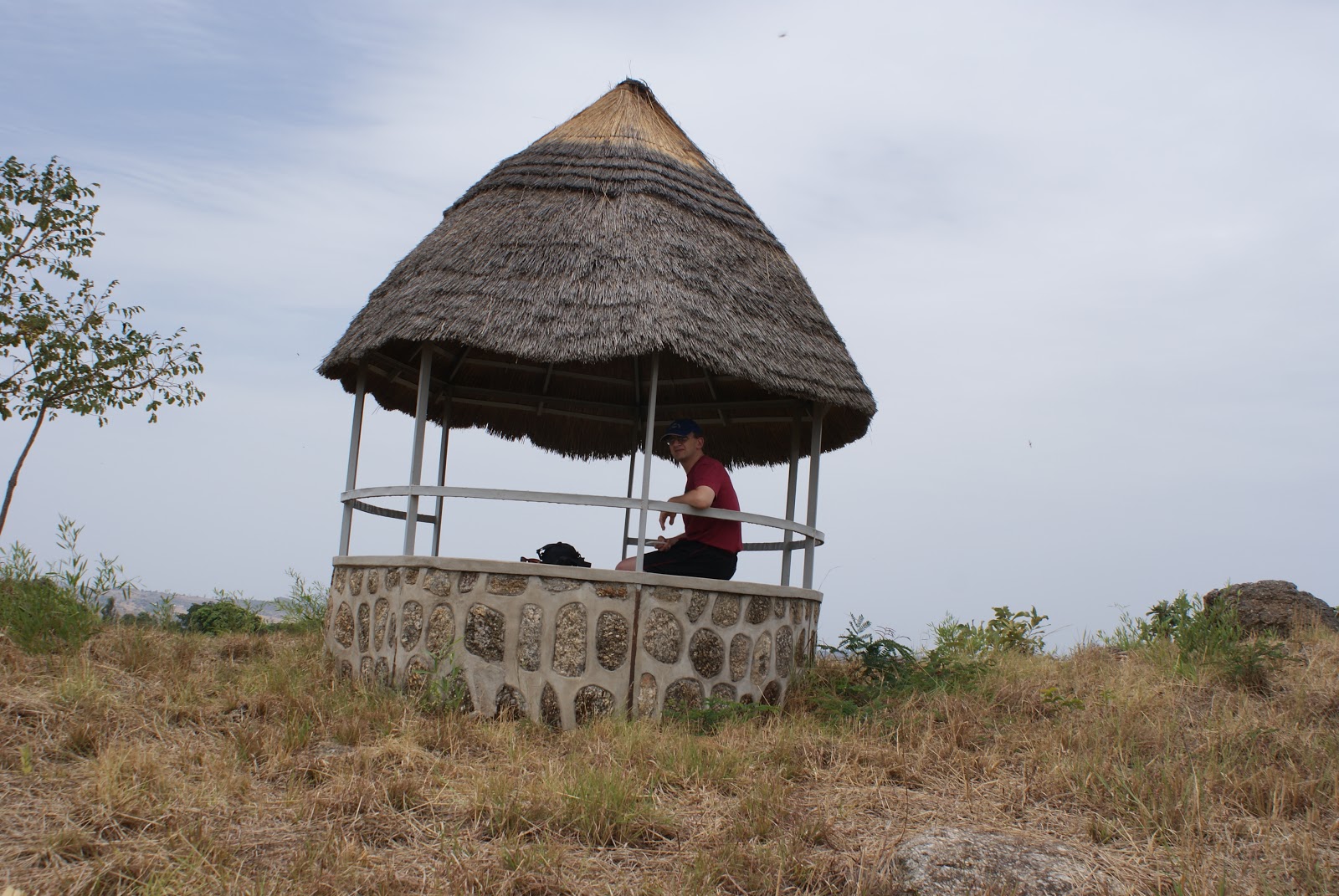
the lounge but climbing up Mount Sanderson to the sound of African birds at 6am on Easter Sunday was a great experience.

With films each night, hikes, plenty of friends for James and Ruth to go off with (we didn’t see much of them over the
Friday's walk
weekend) and someone else to cook the meals, it was a good break.  

The Miango Rest Home (MRH) was founded with the express intention of providing somewhere in-country for missionaries to rest, relax and recharge before heading back to their place of service.  Now it’s used by many Nigerians too and is in fact one of the honeymoon capitals of the country but it still fulfils its original purpose.